
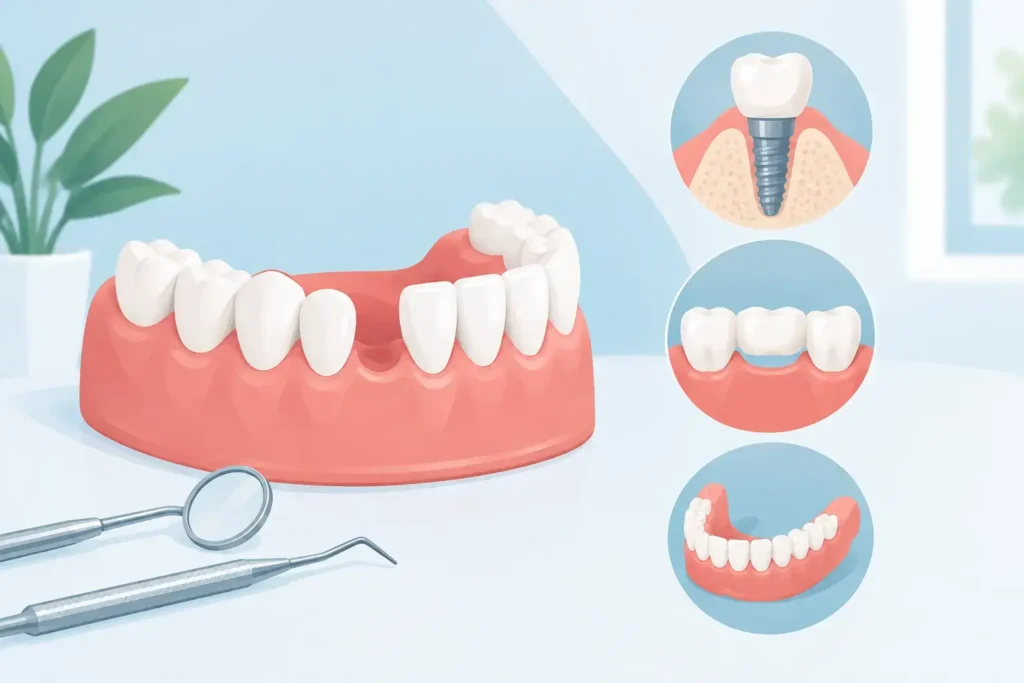
A missing tooth can affect more than a photograph or a favorite meal. It may change how your teeth meet, make certain foods harder to chew, or leave you wondering whether neighboring teeth could shift over time. This guide to replacing missing teeth explains the main options in plain language, including where the decision becomes personal rather than one-size-fits-all.
There is rarely a reason to rush into the first treatment mentioned. The right choice depends on the location and number of missing teeth, the health of your gums and remaining teeth, the condition of the jawbone, your bite, and what feels realistic for your goals and daily life. A dental examination is the place to sort through those details with care.
Why replace a missing tooth?
Some people adapt well after losing a tooth, particularly one near the back of the mouth. Still, an open space can create practical concerns. Teeth beside or opposite the gap may gradually move, which can affect the bite. Missing teeth can also change how force is distributed when you chew. When several teeth are missing, speech, eating, and facial support may be affected.
The American Dental Association explains that tooth replacement can help restore chewing function and appearance. Whether replacement is recommended immediately, later, or not at all is a clinical question. For example, a person missing a wisdom tooth has different needs from someone missing a front tooth or several molars.
The main ways to replace missing teeth
Dental bridges
A dental bridge fills a gap by joining an artificial tooth to support from the teeth on either side. In a traditional bridge, the neighboring teeth are prepared to hold crowns, and the replacement tooth sits between them. Some bridge designs use different types of support, depending on where the gap is and the condition of the surrounding teeth.
A bridge is fixed in place, so it does not come out for cleaning. Many people appreciate that familiar feel and the ability to replace a tooth without a surgical implant procedure. It can be a sensible option when the neighboring teeth already need crowns or have substantial restorations.
The trade-off is that a traditional bridge generally involves altering supporting teeth. It also requires attentive cleaning around and beneath the replacement tooth. A bridge may not be the best fit if those nearby teeth are healthy and minimally restored, or if the supporting teeth and gums cannot reliably handle the forces involved.
Dental implants
A dental implant is a small post placed in the jawbone to support a replacement tooth. After appropriate healing and planning, it can support a crown for one missing tooth or help support other restorations in some situations. Because it is supported independently, an implant does not usually require preparing the teeth next to the gap.
Implants may offer a stable, fixed-feeling option, but they are not automatic choices for every patient. Adequate bone, healthy gum tissues, overall medical history, bite forces, and habits such as smoking all matter in planning. Treatment also takes time and may involve more than one stage. The American Academy of Periodontology notes that implants require ongoing professional monitoring and home care, just as natural teeth do.
Ask whether an implant is appropriate for the specific gap, what preparatory treatment might be needed, and what the expected treatment sequence looks like. If an implant is not suitable now, a bridge or removable option may still restore comfort and function.
Removable partial dentures
A removable partial denture replaces one or more missing teeth and can be taken out for cleaning. It is designed to rest on the gums and may use remaining teeth for support. Modern partial dentures can be made from different materials, so the appearance and feel vary by design.
This option can be particularly useful when several teeth are missing, when a fixed restoration is not advisable, or when someone wants a less invasive approach. It can also be considered while longer-term treatment decisions are being made.
A removable appliance requires an adjustment period. It may feel bulkier than a fixed bridge or implant-supported crown, and its stability depends on the design, fit, and the teeth and tissues available for support. A thoughtful evaluation helps set realistic expectations about chewing and appearance.
Complete dentures
Complete dentures replace all teeth in an upper or lower arch. They are custom-made removable appliances that rest on the gums. For people who have lost all teeth, dentures can restore the appearance of a full smile and make many everyday foods easier to manage.
Dentures are highly individualized. The shape of the jaw, saliva flow, gum tissue, bite, and expectations for stability can all influence the design and experience. Implant-supported denture treatment may be discussed for some people, but candidacy must be evaluated individually. It is reasonable to ask what level of retention is possible with a conventional denture and whether other support options are appropriate.
How to compare your options without pressure
The best questions are not only “Which option is best?” but “Best for what?” A fixed bridge may prioritize a shorter treatment pathway. An implant may preserve neighboring teeth from crown preparation. A removable partial may replace multiple teeth with a different level of investment and invasiveness. Each choice carries benefits and limitations.
During a consultation, ask your dentist to explain how each option would affect the teeth next to the space, how it would be cleaned, what future maintenance may be needed, and what could happen if you postpone replacement. Ask to see how your bite and gum health influence the recommendation. Clear explanations should leave you better informed, not pressured.
It also helps to discuss comfort openly. Dental anxiety is common, and it should not prevent you from asking questions or seeking care. Let the dental team know if past visits have been difficult, if you have a sensitive gag reflex, or if you need information delivered slowly. A calm conversation is part of personalized care.
What happens at a replacement-tooth consultation?
A consultation typically begins with a discussion of your health history, the missing tooth or teeth, and what you hope to change. Your dentist will examine the teeth, gums, and bite and may recommend diagnostic imaging when needed to assess areas not visible during a standard examination. The goal is to understand the foundation before selecting a restoration.
You should expect a conversation about alternatives, not merely a recommendation. If gum disease, decay, an unstable bite, or another concern is present, it may need attention before a replacement tooth can be planned. That is not a setback. It is a way to protect the long-term support for the restoration.
For adults and families in West Hollywood, West Hollywood Smile Dental can provide a consultation to discuss restorative concerns and help you understand which treatment paths may fit your oral health needs. Specific treatment recommendations should follow an in-person examination rather than an online checklist.
Questions worth bringing to your visit
Write down questions before your appointment, especially if you feel nervous. You might ask whether the space needs to be replaced, whether your neighboring teeth are healthy enough to support a bridge, and whether your bone and gums appear suitable for an implant evaluation. Ask what each option will feel like day to day and what cleaning routine it requires.
You can also ask what happens if you wait, whether temporary tooth replacement is appropriate in your situation, and which signs would mean you should call the office sooner. If you are comparing choices, ask the dentist to explain the clinical reason one option may be favored over another. A recommendation should make sense in the context of your mouth, not just in a brochure.
A missing tooth does not have to dictate how confidently you eat, speak, or smile. Start with the questions that matter most to you, and give yourself room to choose care that supports both your health and your comfort.