
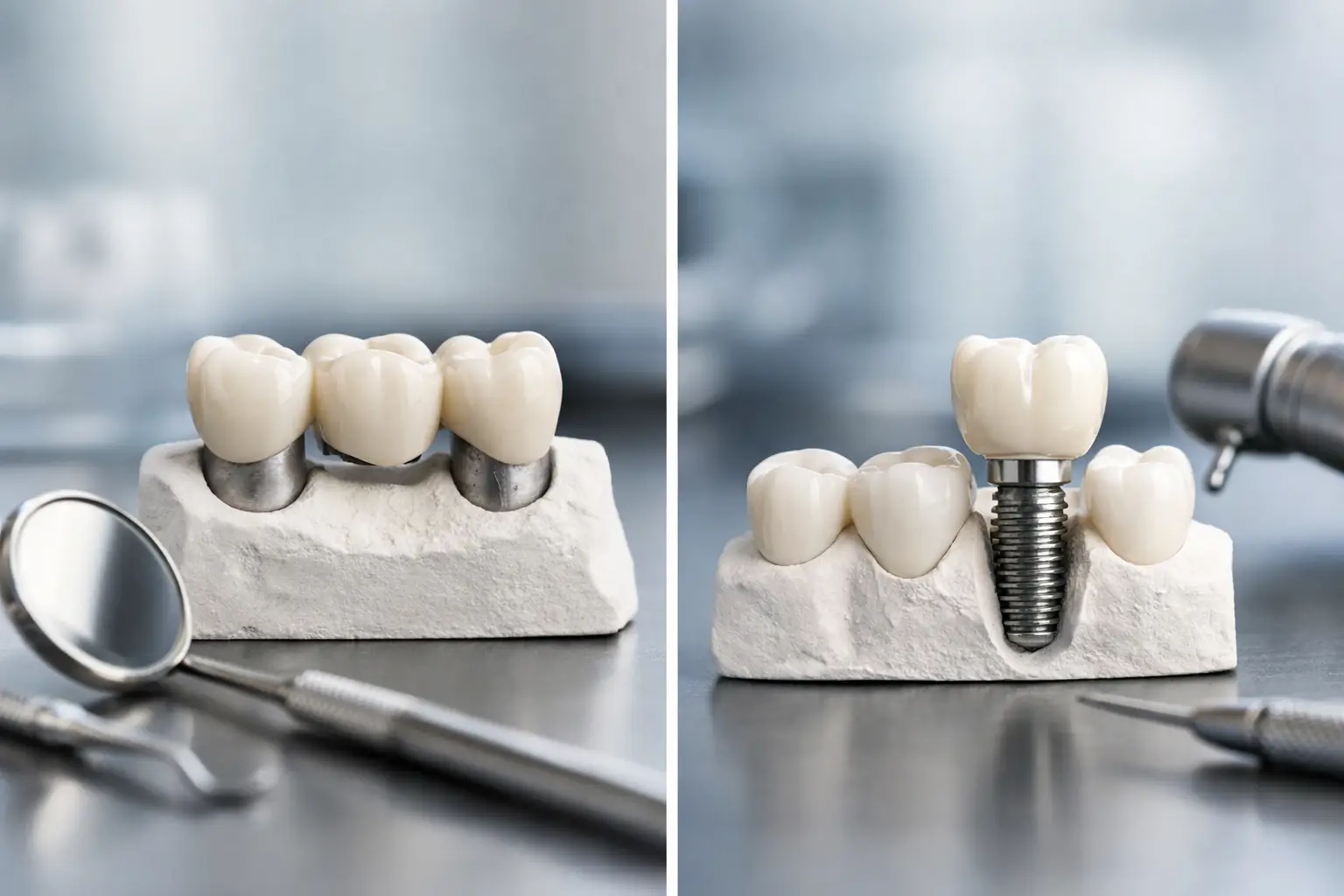
A missing tooth can change more than the way your smile looks in photos. It can affect how you chew, how clearly you speak, and the balance of your bite over time. When considering a dental bridge vs implant, the right answer is rarely one-size-fits-all. Your neighboring teeth, bone health, timeline, budget, and comfort with treatment all matter.
Both options can restore your smile beautifully and help you return to eating and speaking with confidence. The best choice is the one that supports your oral health today while making sense for your life long term.
Dental Bridge vs Implant: The Key Difference
A dental bridge replaces a missing tooth by connecting a replacement tooth, called a pontic, to crowns placed on the teeth beside the gap. Those supporting teeth are shaped to hold the bridge securely in place. A traditional bridge is fixed, meaning it stays in your mouth and is not removed at home.
A dental implant replaces the tooth root as well as the visible tooth. A small titanium post is placed in the jawbone, where it gradually fuses with the bone. Once healing is complete, a custom crown is attached to the implant. The finished result is designed to look, feel, and function much like a natural tooth.
Both treatments are well-established restorative options. The difference is in how they are supported and how they affect the surrounding teeth and jawbone.
When a Dental Bridge May Be the Better Choice
A bridge can be an excellent solution when a patient wants to replace a tooth without surgery or needs a restoration on a shorter timeline. Because a bridge does not require the same bone-healing period as an implant, treatment can often be completed more quickly.
It may also make sense when the teeth on either side of the missing tooth already need crowns because of large fillings, cracks, wear, or existing damage. In that situation, placing crowns as part of a bridge may efficiently restore several needs at once.
A bridge can also be appropriate for patients whose health history, jawbone condition, or personal preference makes implant surgery less desirable. Comfort matters. A personalized treatment conversation should account for your medical history, anxiety level, and goals, not just the empty space in your smile.
The trade-off is that a traditional bridge relies on neighboring teeth. Even healthy teeth generally need to be reshaped to support it. Bridges also require careful cleaning underneath the replacement tooth, typically with floss threaders or other tools recommended by your dental team.
When a Dental Implant May Be the Better Choice
For many adults with one missing tooth, an implant is the most conservative choice for the surrounding natural teeth. It stands independently, so the teeth next to the gap do not need to be prepared for crowns.
Implants also help stimulate the jawbone in the area where the tooth root once was. After tooth loss, the bone can gradually shrink because it no longer receives the normal forces of chewing. While an implant cannot reverse every change that has already occurred, it can help preserve bone after replacement.
An implant may be especially appealing if you want a replacement that feels stable while eating and speaking, or if the neighboring teeth are healthy and untouched. With good home care and regular professional visits, an implant restoration can be a durable long-term option.
The main consideration is time. Implant treatment usually involves a surgical placement appointment followed by a healing period before the final crown is delivered. Some patients also need bone grafting before or during treatment if there is not enough healthy bone to support the implant. This adds time and can add to the total cost.
Cost Is More Than the Initial Fee
It is understandable to compare a dental bridge and implant based on the initial investment. A bridge often has a lower upfront cost than a single implant, particularly when bone grafting or other preparatory care is needed for the implant.
However, the full financial picture includes maintenance, expected lifespan, and the condition of nearby teeth. A bridge may eventually need replacement, and the supporting teeth remain part of the restoration plan. An implant crown can also need repair or replacement over time, but the implant post itself may last for many years when it is properly cared for.
Insurance coverage varies widely. Some plans contribute more toward bridges than implants, while others offer partial benefits for both. Before choosing treatment, ask for a clear explanation of the recommended steps, likely costs, insurance benefits, and available payment options. Feeling informed before treatment is part of feeling comfortable with treatment.
Appearance, Comfort, and Everyday Function
Modern bridges and implant crowns can both be made to match your natural tooth color, shape, and bite. The goal is not simply to fill a gap. It is to create a restoration that looks natural when you smile and feels comfortable when you chew.
An implant often feels more like an individual natural tooth because it is rooted in the bone and stands alone. A bridge can also feel very natural, especially after you adjust to it, but it is connected to adjacent crowns and requires a different cleaning routine.
Your bite matters as much as appearance. If you grind or clench your teeth, have a history of cracked restorations, or have bite alignment concerns, your dentist may recommend protective steps such as a nightguard or additional treatment. A beautiful restoration should also be built to handle the way your teeth function every day.
What the Treatment Process Feels Like
For a bridge, the supporting teeth are prepared and scanned or impressed. You may wear a temporary bridge while a dental laboratory creates your final restoration. At the placement visit, your dentist checks the fit, color, and bite before securing it.
For an implant, the first phase is placement of the implant post. Local anesthesia is used to keep you comfortable, and sedation options may be available for patients who feel anxious about dental procedures. Most people describe the recovery as manageable, though tenderness and swelling can occur for a few days.
After the implant heals and integrates with the bone, a final crown is created and attached. The exact schedule varies. Some cases qualify for quicker protocols, while others benefit from allowing more healing time for a predictable, stable result.
Questions That Help You Choose
The decision becomes clearer when you look beyond the missing tooth itself. Consider whether the teeth next to the space are healthy or already need crowns. Think about whether you prefer to avoid surgery, how quickly you need the tooth replaced, and whether you are comfortable committing to a longer treatment process for an implant.
Your dentist should also evaluate gum health, bone volume, bite forces, medical history, and the location of the missing tooth. Replacing a front tooth can involve different esthetic priorities than replacing a molar that handles heavy chewing pressure. If several teeth are missing, options such as implant-supported bridges may also be worth discussing.
Caring for Your New Restoration
Neither a bridge nor an implant can get a cavity, but the teeth and gums around them still need consistent care. Brush twice daily, clean between teeth every day, and keep up with professional cleanings and exams. Gum disease can threaten the tissues supporting an implant, while decay or gum problems can compromise the teeth holding a bridge.
With an implant, use the cleaning tools your dental team recommends around the crown and gumline. With a bridge, make a habit of cleaning under the pontic, where plaque can collect if it is missed. Small daily routines protect the investment you have made in your smile.
A thoughtful exam and a conversation about your priorities can turn a stressful choice into a clear plan. Whether a bridge or implant is right for you, replacing a missing tooth is a positive step toward comfortable chewing, a confident smile, and lasting oral health.